By: Hesham Sherghin
Some people avoid the dentist for a few months. Others avoid it for fifteen years.
If you belong to the second group, you probably already know the pattern. A small problem becomes a bigger one. The bigger problem becomes harder to face. Embarrassment gets added to the fear, and the two feed each other until the idea of sitting in a dental chair feels genuinely impossible — not inconvenient, not unpleasant, but impossible.
That experience is far more common than most people realise, and it is not a character flaw. It is also solvable. Sleep dentistry exists precisely for the people who cannot get through treatment any other way — and, just as importantly, for people whose medical or dental situation is complicated enough that doing everything in one carefully controlled setting is simply the better plan.
This article explains who sleep dentistry is for, and then spends most of its length on a question patients rarely think to ask: how do you decide where to have it done? That second question matters more than most people realise.
What “sleep dentistry” actually means
This is worth clarifying up front, because the phrase gets used loosely and that causes real confusion for patients comparing their options.
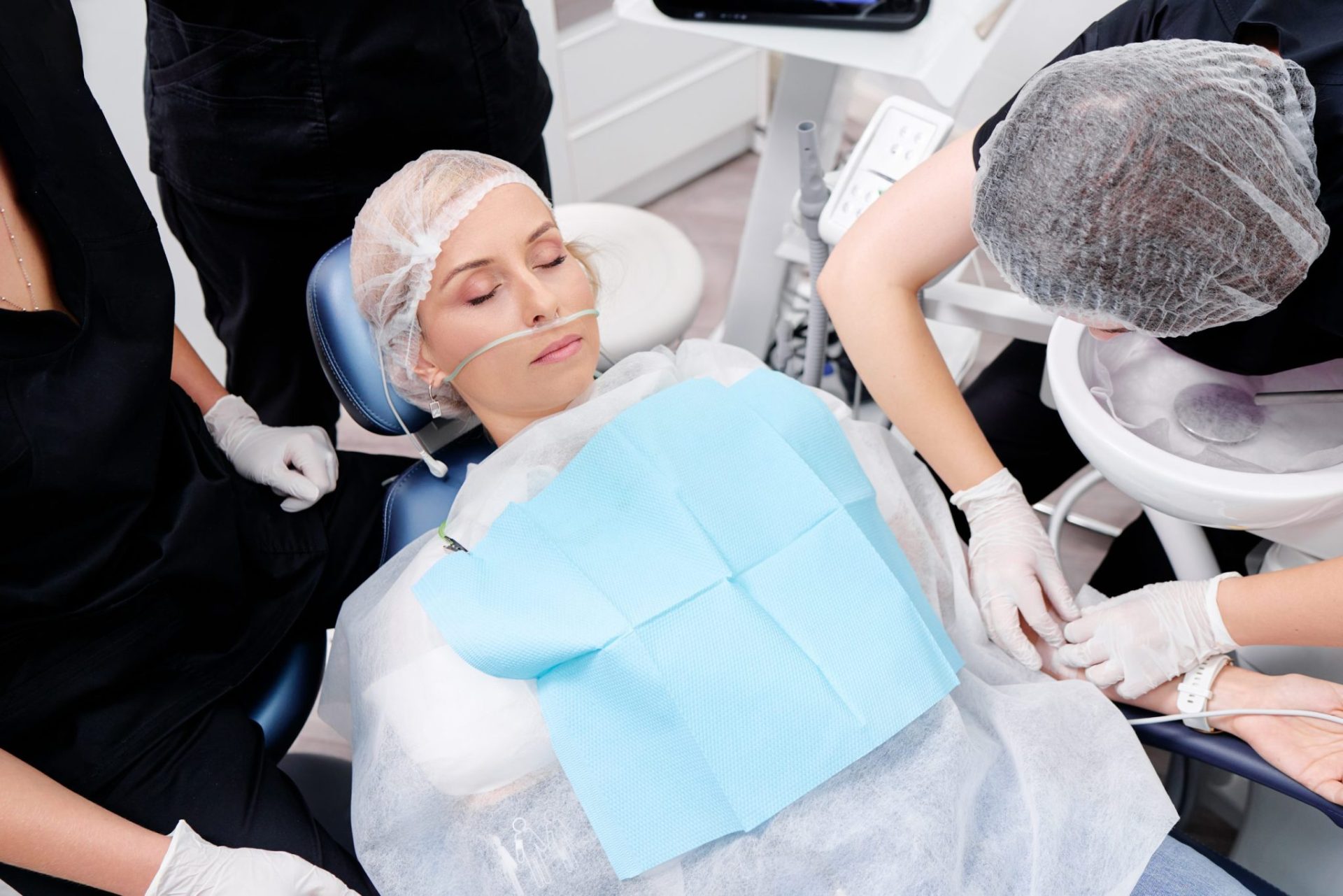
In Ontario, sleep dentistry means deep sedation or general anesthesia. Under deep sedation, you are not easily roused and will not respond to what is happening around you. Under general anesthesia, you are fully unconscious. In both cases your breathing, heart rhythm, and vital signs are managed continuously by a dedicated anesthesia provider, and you will have no memory of the procedure. This is genuinely being asleep.
Other options exist and are perfectly good options — they are simply not the same thing:
- Nitrous oxide. Inhaled through a nose mask. Takes the edge off, wears off within minutes, and you drive yourself home.
- Oral sedation. A tablet taken before the appointment. You remain awake and responsive, though relaxed and often hazy about the details afterwards.
- IV sedation. Medication delivered through a vein. You remain conscious and able to respond, even if you remember little of it.
The common thread in all three is that you remain conscious. They are effective for mild to moderate anxiety and for shorter procedures, and for many patients they are exactly the right choice. But they are not sleep dentistry, and they are not equivalent to it. If your fear is severe, if your medical situation is complex, or if you need extensive treatment completed in a single session, the lighter options are unlikely to get you there.
The distinction matters when you are comparing providers. A practice advertising “sleep dentistry” while offering oral sedation or IV sedation is offering something meaningfully different, and it comes with different training requirements, different facility standards, and a different level of oversight. It is a fair question to ask directly.
Who benefits most
Sedation and anesthesia are formally recognised as appropriate for treating patients whose fear or anxiety prevents dental care, and for those with cognitive impairment or physical conditions that make conventional treatment unworkable. In practice, the people who benefit tend to fall into a few groups.
Severe dental phobia
This is more than nervousness. It is the person who cancels appointments the night before, who cannot tolerate the sound of the drill, who has panic symptoms in the waiting room, or who once had a traumatic experience and has never gone back. It also includes people with a gag reflex so strong that even an examination becomes impossible. For these patients, sedation is not a luxury — it is the only realistic route to treatment.
Medical complexity
Some patients have conditions that make an ordinary dental appointment risky or impractical: movement disorders, seizure conditions, cardiac or respiratory disease requiring careful monitoring, cognitive impairment, or a history of severe reactions to previous procedures. Treating these patients in an environment with full monitoring and a dedicated anesthesia provider is often safer than treating them in an ordinary operatory.
Dental complexity
This group is often overlooked. If years of avoidance have left you needing extractions, root canals, fillings, gum treatment, implants, and new teeth, then the traditional route is fifteen to twenty separate appointments spread across a year or more — each one a fresh opportunity to lose your nerve. Consolidating that into one or two planned sessions under anesthesia is not just kinder. It is frequently the only version of the plan that ever gets finished.
The part patients rarely research: where to go
Most people researching sleep dentistry compare price and location. Those are reasonable things to compare. They are not the important ones.
When you are asleep, you delegate everything — your airway, your safety, and every clinical decision made while you cannot participate — to the team in that room. What follows is what actually deserves your attention.
1. The breadth of the dentist’s training
Time under anesthesia is a finite resource. Whatever cannot be completed in that window becomes a second anesthetic, a second recovery, and a second bill.
This is why the range of what a single dentist can perform matters so much. A clinician who is trained and experienced across fillings, cleanings and gum therapy, advanced extractions, complex root canals, implant placement, bone and soft tissue grafting, and full-mouth reconstruction can address whatever is found, in one session. A clinician with a narrower scope has to refer the rest, which means the patient who needed one anesthetic now needs more.
Breadth matters for a second reason that is less obvious. Plans change once treatment begins. A tooth that looked restorable on the X-ray turns out to be cracked below the gum. A socket is thinner than expected and needs grafting. If the dentist can only perform part of the plan, that discovery becomes a delay. If the dentist can perform all of it, the plan simply adapts while you sleep. Ask directly which procedures the dentist personally performs, and which get referred elsewhere.
2. The team around the dentist
The single most important safety principle in sedation is separation of roles. The person performing your dentistry should not also be the person responsible for watching you breathe. Those are two demanding full-time jobs, and combining them is where sedation care becomes fragile.
A properly staffed sleep dentistry team includes:
- A dedicated anesthesia provider — a dental anesthesiologist or a medical anesthesiologist — whose only responsibility is your airway, your depth of anesthesia, and your vital signs, from induction through to recovery.
- Anesthesia support staff — registered nurses or respiratory therapists trained specifically in airway management, monitoring, and emergency response, rather than dental staff asked to watch a monitor while assisting.
- Trained surgical assistants who know these procedures well enough to anticipate the next instrument rather than search for it, which directly shortens your time asleep.
- Recovery staff who monitor you after the procedure until you meet defined discharge criteria — not simply until the chair is needed.
- A treatment coordinator who handles sequencing, consent, financing, and follow-up, so that the clinical team stays focused on clinical work and you are not left navigating logistics on your own.
There is one credential worth asking about by name: Advanced Cardiac Life Support, or ACLS.
ACLS is structured training in recognising and managing cardiac and respiratory emergencies — interpreting heart rhythms, managing an airway, using a defibrillator, giving emergency medications, and, critically, coordinating a team during a resuscitation. It is not an online module. Certification requires hands-on assessment and has to be renewed.
Ontario’s Standard of Practice requires the provider who administers deep sedation or general anesthesia to hold current ACLS certification, including a hands-on component. That is the floor. The stronger position — and the one worth looking for — is a room in which every clinician holds it: the dentist, the anesthesiologist, and the nurse or respiratory therapist supporting them.
The reason is practical. In an emergency, roles collapse quickly. The dentist may have instruments in the patient’s mouth. The anesthesiologist is committed at the head of the chair. The support clinician may be the one nearest the emergency drugs or the defibrillator. If all three have trained to the same standard, they function as a single resuscitation team, each able to take any role, speaking a shared vocabulary under pressure. If only one or two are trained, everyone else becomes a bystander waiting for direction at exactly the moment direction is most expensive.
This matters most on a full surgical day. Sleep dentistry facilities frequently treat several patients in sequence, and readiness has to hold from the first case to the last — through turnover, breaks, and staff rotation. A team in which every clinical member carries current ACLS maintains that standard continuously, rather than depending on whether one particular individual happens to be in the room.
Ask who will be in the room, what each person’s training is, and who is responsible for your airway. A well-run facility will answer without hesitation.
3. The facility itself
A sleep dentistry facility has to be two things at once, and many are only one.
It must be a genuine medical anesthetic environment. In Ontario, facilities where sedation or general anesthesia is administered must hold a current facility permit from the Royal College of Dental Surgeons of Ontario, must meet defined standards for equipment, monitoring, drugs, and personnel, and are subject to on-site inspection. Serious adverse events must be reported to the College. This is not a formality — it is the framework that makes office-based anesthesia accountable, and you are entitled to ask whether a facility holds a current permit and to verify a practitioner’s sedation authorization on the College’s public register.
Practically, that environment means continuous monitoring of heart rhythm, blood pressure, oxygen saturation, and exhaled carbon dioxide; a reliable oxygen supply with backup; suction; a defibrillator; current emergency medications; and a designated recovery area with trained staff. None of this is visible in a waiting room, which is exactly why it is worth asking about.
At the same time, the facility must be a fully equipped dental surgical suite. This is where the equipment list genuinely earns its place, because under anesthesia every technology that saves a step saves you time asleep:
- Same-day crown technology. Digital scanning and in-house milling mean a permanent crown can be designed and fitted during the same session. Without it, you leave with temporary crowns and return for another appointment — which for a phobic patient is precisely the appointment that gets cancelled.
- Surgical microscopes. Magnification and coaxial light make the difference between finding a hidden root canal on the first attempt and not finding it at all. Precision under magnification means fewer repeat procedures.
- Advanced surgical motors. Controlled, calibrated drilling for implant placement, with accurate torque measurement. This protects bone during preparation and gives objective information about implant stability.
- Piezosurgery. Ultrasonic instruments that cut bone but not soft tissue. Around the sinus, the nerve canal, or a delicate socket wall, that selectivity meaningfully reduces the risk of injury and tends to improve healing.
- Dental lasers. Useful for gum contouring, decontaminating around implants, and controlling bleeding in a single pass.
- 3D imaging (CBCT). Planning implants and complex extractions in three dimensions before the day, so the surgery follows a plan rather than improvising around surprises.
A facility with the medical equipment but not the dental technology can keep you safe while doing limited work. A facility with the dental technology but not the medical infrastructure should not be putting you to sleep at all. You want both, in the same building, on the same day.
4. How often they actually do this
This is the simplest question on the list and possibly the most revealing: how many cases like mine does this team do in a month?
Teams that perform full-mouth treatment under anesthesia regularly develop something that cannot be bought — rhythm. Roles are settled. Instruments are laid out in a familiar order. Emergency protocols have been rehearsed rather than read. Complications are recognised early because they have been seen before. A team doing this weekly operates differently from a team doing it occasionally, and the difference shows up in how long you are asleep and how smoothly the day runs.
Questions worth asking before you book
- Does this facility hold a current sedation or anesthesia facility permit, and what level of sedation is being proposed for me?
- Who administers the anesthesia, and is that their only role during my procedure?
- What are the qualifications of the staff monitoring me during treatment and in recovery?
- Which of my procedures will this dentist perform personally, and which would be referred?
- Can everything in my plan realistically be completed in one session, and what happens if it cannot?
- Does everyone in the room — the dentist, the anesthesia provider, and the nursing or respiratory therapy staff — hold current, hands-on ACLS certification?
- What monitoring equipment is used, and what emergency equipment is on site?
- How often does this team treat cases of similar complexity?
- What is the recovery process, and what are the criteria for sending me home?
An honest word about risk
Sedation and general anesthesia are safe when they are done properly, and “properly” is doing real work in that sentence. Safety comes from careful patient selection, thorough medical assessment, appropriate monitoring, trained personnel, and a facility prepared for the rare occasion when something goes wrong.
Not everyone is a candidate, and a responsible team will tell you so. Certain medical conditions, airway characteristics, untreated sleep apnea, or a particular level of medical risk may mean that treatment belongs in a hospital setting instead, or that a lighter level of sedation is the better choice. If a provider agrees to put you to sleep without a thorough medical history, a physical assessment, and a frank conversation about risk, that is a meaningful warning sign.
The point of all this
Sleep dentistry is not about avoiding dentistry. It is about finally receiving the care that fear, complexity, or circumstance has kept out of reach — often for years.
Many patients describe the experience afterwards in almost identical terms: a sense of disbelief that something they dreaded for so long was handled in a single day, and a quiet frustration that they did not do it sooner. Getting there safely depends on the choices made before you ever sit down — the training of the dentist, the composition of the team, the capability of the facility, and how often they do this work.
Those are the things worth researching. Ask the questions. A team that does this well will welcome them.
Frequently Asked Questions
What is the difference between sleep dentistry and sedation dentistry?
Sleep dentistry specifically means deep sedation or general anesthesia, where you are either not easily roused or fully unconscious, with no memory of the procedure. Sedation dentistry is a broader term that also includes nitrous oxide, oral sedation, and IV sedation, all of which keep you conscious and responsive. A practice advertising “sleep dentistry” while actually offering one of the lighter conscious options is describing something meaningfully different.
Who is a good candidate for sleep dentistry?
Three groups tend to benefit most: patients with severe dental phobia that prevents them from tolerating any conventional treatment, patients with medical complexity such as movement disorders, seizure conditions, or cardiac and respiratory disease that make monitored care safer, and patients with significant dental complexity who need extensive treatment consolidated into one or two sessions rather than fifteen or twenty separate appointments.
What questions should I ask before choosing a sleep dentistry provider?
Ask whether the facility holds a current sedation or anesthesia permit, who administers the anesthesia and whether that is their only role during your procedure, which parts of your treatment plan the dentist performs personally versus refers out, whether everyone in the room holds current hands-on ACLS certification, and how often the team treats cases of similar complexity to yours.
What is ACLS certification and why does it matter for sleep dentistry?
ACLS, or Advanced Cardiac Life Support, is hands-on training in recognising and managing cardiac and respiratory emergencies, including airway management, defibrillator use, emergency medications, and coordinating a resuscitation team. In Ontario, the provider administering deep sedation or general anesthesia must hold current ACLS certification. A stronger safety standard is when every clinician in the room, not just the anesthesia provider, holds it, since roles can shift quickly during an emergency.
Is it safe to have all my dental treatment done in one session under anesthesia?
It can be, provided the facility and team are equipped for it. Safety depends on a dentist with broad enough training to complete or adapt the plan without needing a second anesthetic, a team with clearly separated roles between the person treating you and the person monitoring your vital signs, and a facility with both genuine medical-grade monitoring equipment and the dental technology to complete treatment efficiently. Not every patient is a candidate, and a responsible provider will say so after a full medical and dental assessment.
What equipment should a sleep dentistry facility have?
A facility needs medical anesthesia equipment such as continuous monitoring of heart rhythm, blood pressure, oxygen saturation, and exhaled carbon dioxide, a backup oxygen supply, a defibrillator, and emergency medications. It should also have dental technology that shortens time under anesthesia, such as same-day crown milling, surgical microscopes, calibrated surgical motors, piezosurgery, dental lasers, and 3D imaging. A facility with only one half of this equipment is not fully equipped for sleep dentistry.
This article is general information and is not a substitute for a personal consultation. Whether sedation or general anesthesia is appropriate for you can only be determined after a full medical and dental assessment.